We know the problem exists. How does a transport operator systematically manage it?
WSRI is a developing methodology exploring how road transport operators can identify, understand and manage risks affecting the human capacity on which their operations depend.
Originated and developed by Wayne Reidie MBA FCILT, Director of Customer 1st (UK) Ltd. Developmental research: not a validated methodology, regulatory standard or component of OCRS.
01 / The management gap
From recognising the problem to managing the risk
Driver health, wellbeing, fatigue, sleep, recovery and working conditions are already recognised as important issues within road transport. Awareness alone does not give an operator a systematic management response.
Operators routinely bring together evidence about vehicle roadworthiness, maintenance, defects, drivers’ hours, compliance, incidents and operational performance. WSRI asks whether a comparable integrated approach can make workforce sustainability more visible.
What does the operator actually do about it? Which signals matter, how should they be interpreted, and what action is proportionate to the circumstances?
WSRI seeks to explore that practical gap. It is a risk-management research methodology for road transport, rather than simply a wellbeing questionnaire, satisfaction survey, mental-health assessment or commercial HR product.
WSRI aims to bridge the gap between recognising the problem and systematically managing the risk.
02 / Prevention and human capacity
We would not run a vehicle to failure.
Why should we allow human capacity to run to failure?
Transport operators inspect vehicles, monitor their condition, identify defects, take action and review performance. The research asks whether that preventative management philosophy can also help organisations recognise signals of pressure on human capacity before operational failure occurs.
People are not machines. The analogy concerns the discipline of prevention. Human circumstances are complex, individual and influenced by work and life beyond work; an indicator requires context, investigation and a proportionate response.
03 / How WSRI works
Three perspectives. A more informed management picture.
The developing methodology brings together organisational arrangements, workforce experience and operational evidence. Its central principle is triangulation: compare what different sources say rather than rely on a single score or policy.
Organisation
What systems, policies, responsibilities and management controls are in place?
Workforce
What are drivers and other workforce participants actually experiencing?
Operation
What does measurable operational evidence tell us?
↓ WSRI
Compare
Identify
Understand
Assess
Manage
Review
A fatigue policy may look comprehensive while drivers report inadequate recovery. Recorded working hours may appear reasonable while other indicators suggest pressure. Absence, turnover or reliance on agency drivers may change even when formal systems do not.
The discrepancy between evidence sources may itself become a management signal. It is a reason to investigate, rather than proof of a particular cause.
The metric identifies the signal. The investigation establishes the meaning.
04 / Sustainable Transport Leadership Cycle
From risk signals to a structured response
WSRI seeks to identify and assess Workforce Sustainability Risk. The Sustainable Transport Leadership Cycle (STLC) provides the structured management process for responding to it.
Identify
Assess
Understand
Intervene
Review
Learn
A continuing cycle: learning informs the next identification and assessment of risk. These are the six stages of STLC.
05 / Maintaining balance
Sustainable transport management is about balance.
Transport operators face genuine commercial, regulatory and operational pressures. The research does not treat commercial performance as inherently opposed to wellbeing. It explores how management can balance the needs of the operation, the customer and the human capacity required to deliver safely, compliantly and sustainably.
06 / Interpreting a risk profile
A signal for attention, not a judgement of people
The developing methodology may use a Green, Amber and Red risk profile to identify areas requiring management attention. Thresholds, interpretation and usefulness require testing.
Green
A category within the proposed risk profile. It is not a guarantee that no workforce risk exists.
Amber
A potential signal for closer investigation and management attention, considered with the wider evidence.
Red
A potential need for investigation or intervention. Red does not automatically mean a bad operator.
A good operator may encounter Red conditions. The important questions are whether it recognises and understands the risk, responds appropriately, reviews the response and works to restore sustainable operating conditions.
RAG is not a diagnosis, an assessment of an individual employee, proof that an operator is good or bad, or a current regulatory score.
07 / Research and development
Developing the methodology through scrutiny
WSRI originated from Wayne Reidie’s earlier research into driver wellbeing and workforce issues. The work has developed into a broader investigation of Workforce Sustainability Risk within road transport.
WSRI is a developing research methodology. It requires stakeholder scrutiny, operator and driver participation, academic challenge, real-world piloting, independent evaluation and refinement over time.
Keeping evidence and interpretation separate
The recent Level 1 Established Framework Baseline Audit is a prototype for recording organisational policies, responsibilities and formal management arrangements. A recorded “Yes” establishes presence, not effectiveness. A “No” is not, by itself, a Red risk judgement. This distinction supports the wider need to compare formal arrangements with experience and operational evidence.
The next stage is to move the methodology from development into stakeholder scrutiny and real-world operational testing.
The public page describes the research proposition. It does not provide an automated assessment, diagnostic service or validated scoring tool.
Development examples
Inside the developing WSRI toolkit
These extracts and design concepts show how the methodology could be put into practice. They are development material for discussion and scrutiny, not a validated assessment service.
Audit template: an evidence-led starting point
Level 1 — Established Framework Baseline Audit · Prototype v0.1
This baseline records whether arrangements are present and evidenced. A “Yes” does not establish effectiveness or workforce sustainability; a “No” is not automatically a red risk rating. Any “N/A” requires justification.
LG01 · Is responsibility for occupational health and safety formally allocated within the organisation?
Evidence / guidance
Named role, policy, organisation chart, job description or equivalent formal allocation.
Origin / evidence base
ISO 45001; FORS; DVSA ER
Response
Y / N / N/A
Evidence / notes
—
LG02 · Does the allocated health and safety responsibility explicitly include workforce health and/or wellbeing?
Evidence / guidance
Policy, role description or other documented allocation that includes workforce health/wellbeing.
Origin / evidence base
ISO 45001; DVSA ER; FORS
Response
Y / N / N/A
Evidence / notes
—
LG03 · Does the organisation have a documented health and safety policy or equivalent formal statement of arrangements?
Evidence / guidance
Current policy or equivalent documented arrangements; note small-operator provisions where applicable.
Origin / evidence base
ISO 45001; DVSA ER; FORS
Response
Y / N / N/A
Evidence / notes
—
Three sample items reproduced from the supplied draft template. References to existing frameworks record the template’s evidence base; they do not establish certification, endorsement or compliance. The full audit template is not offered for download.
What the digital tool could look like
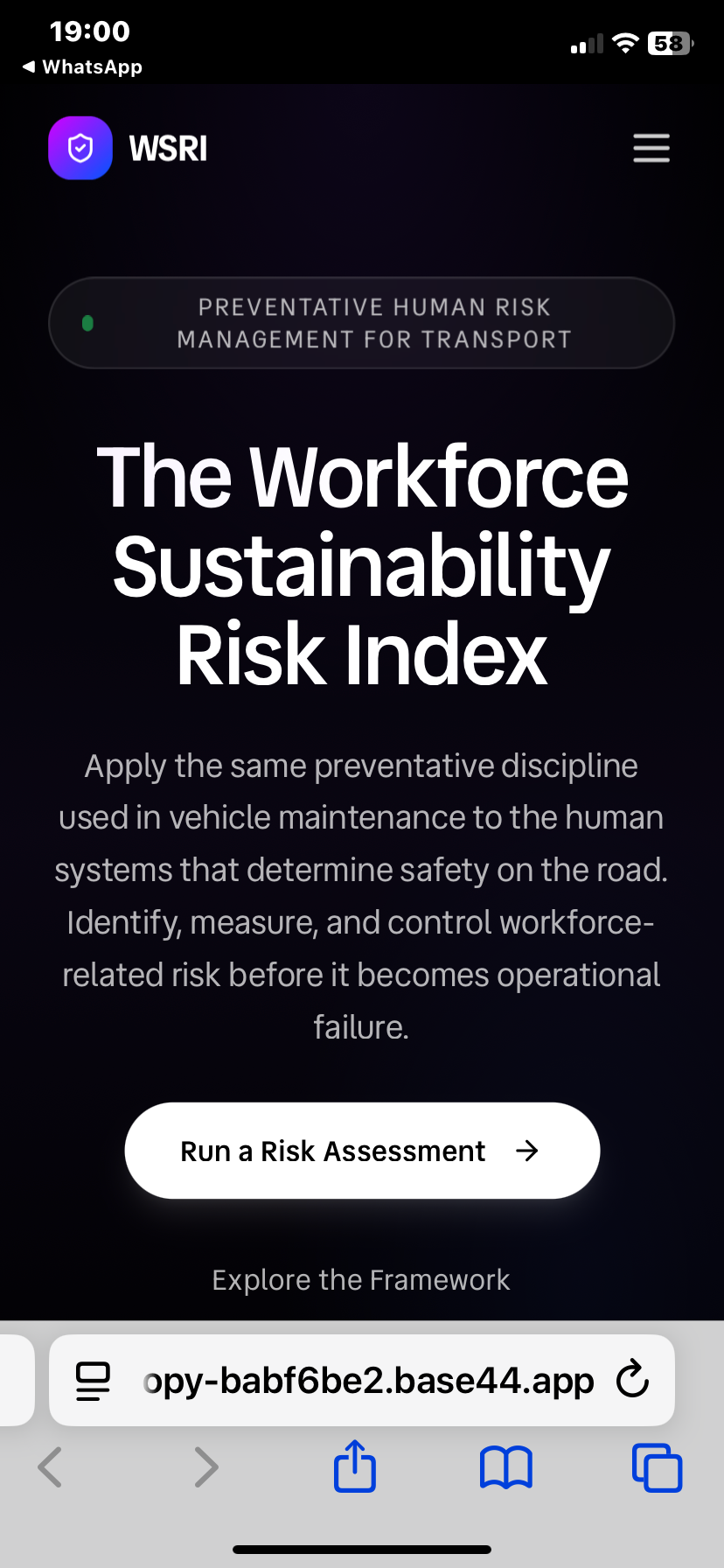
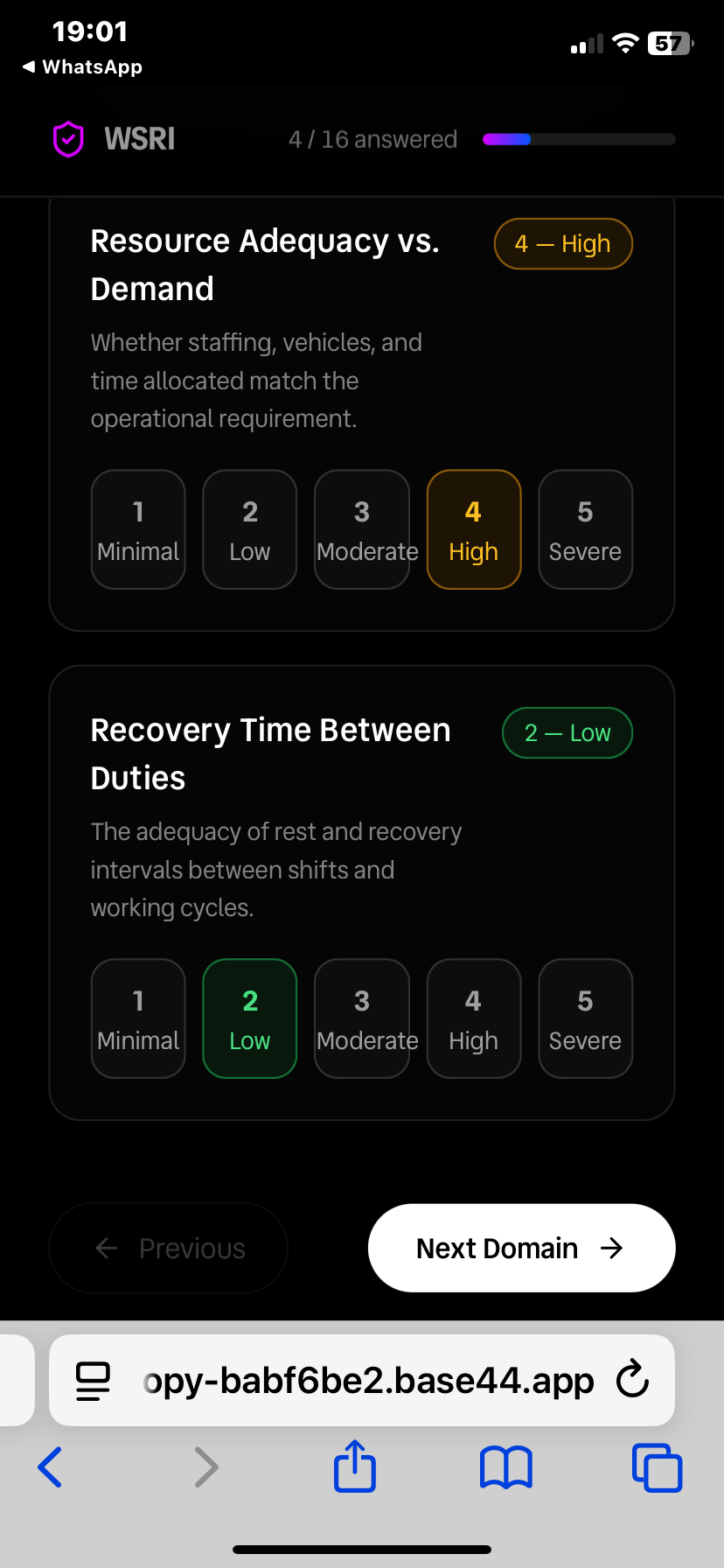
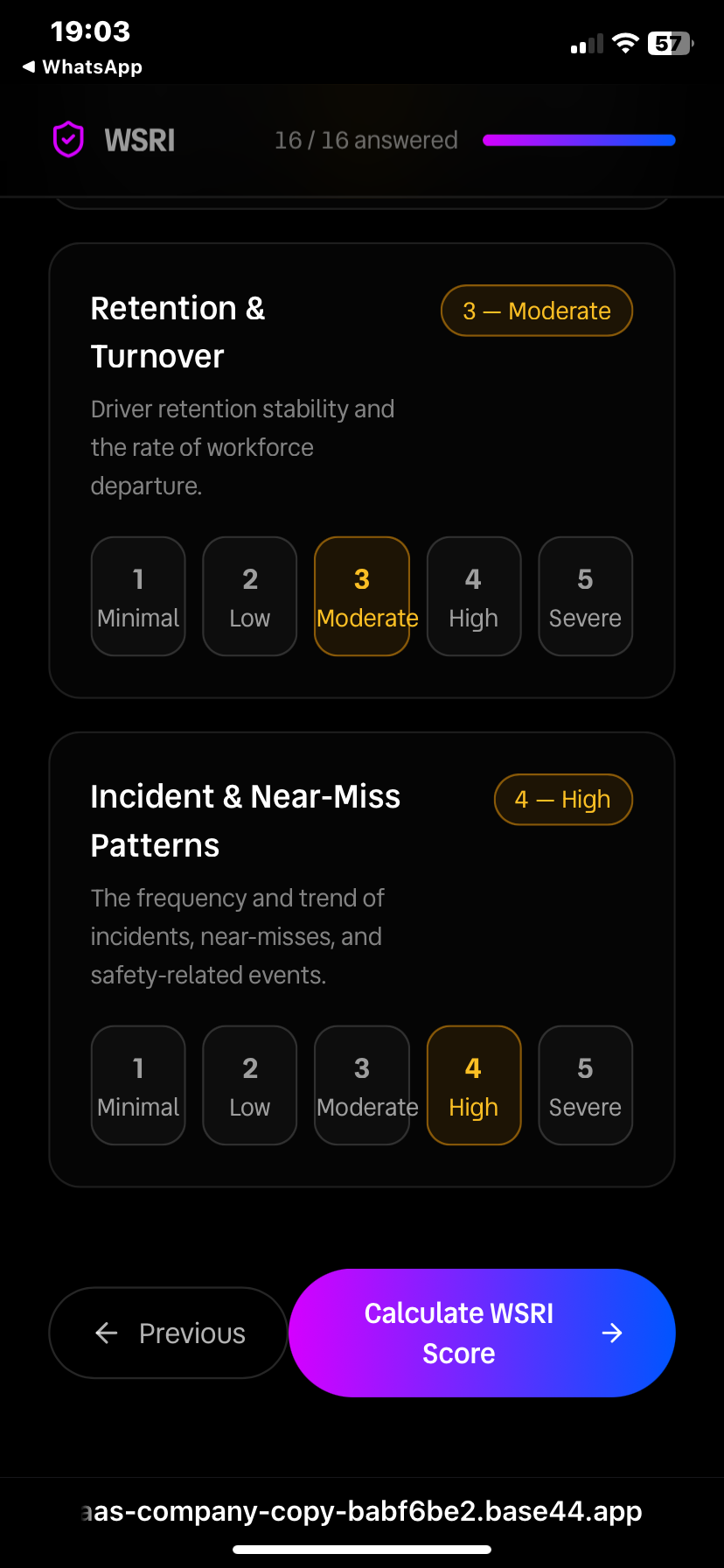
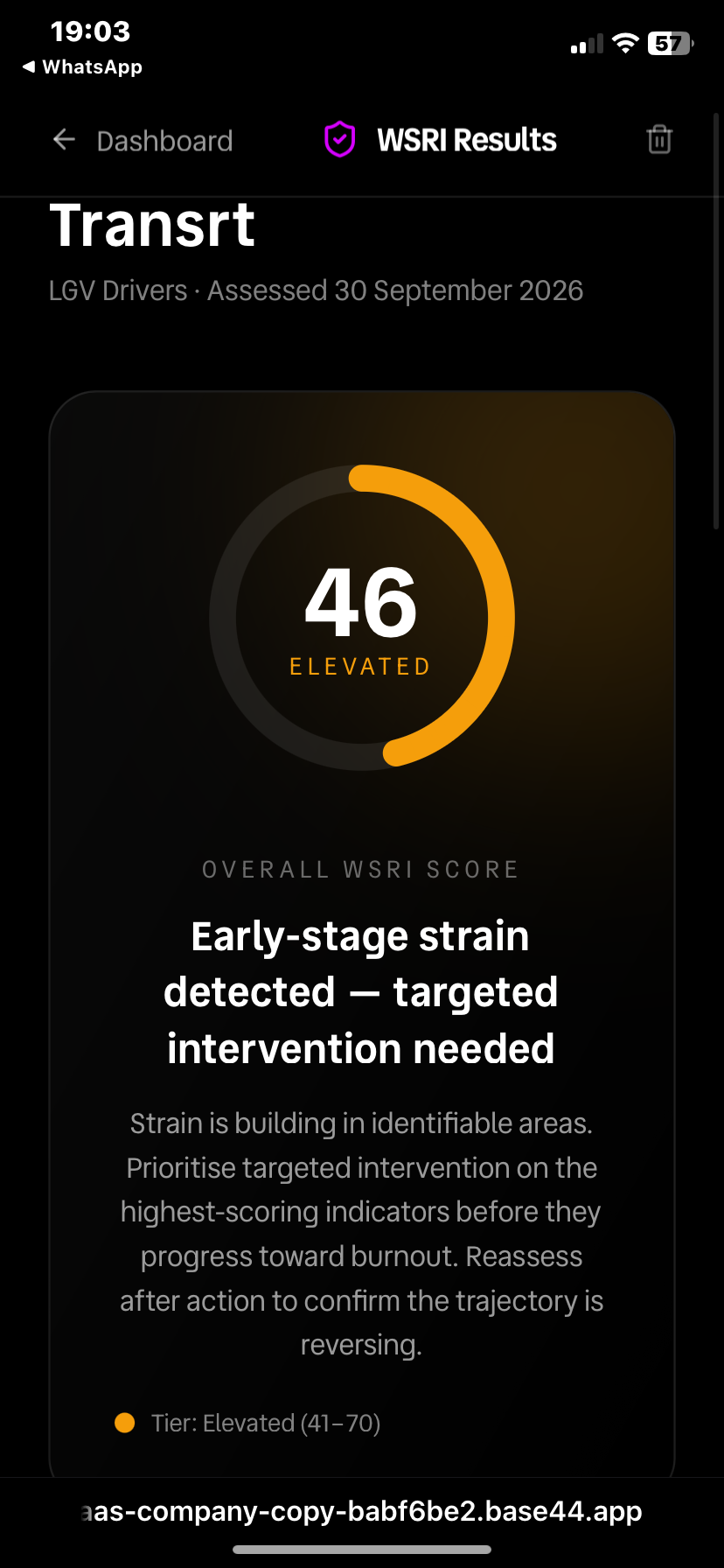
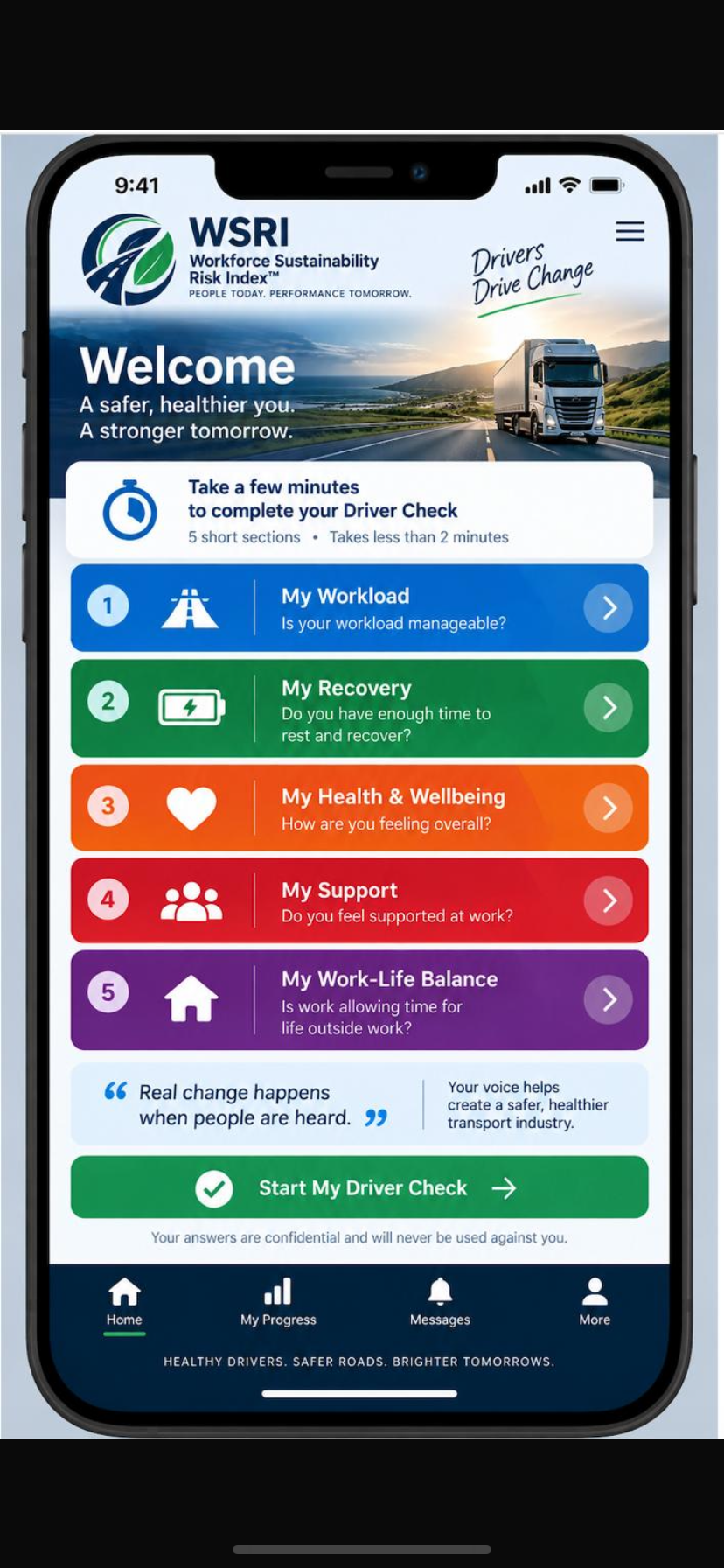
The supplied app screenshots illustrate proposed navigation, indicator entry, workforce input and risk-profile presentation.
Prototype welcome screen An example introduction to the developing workforce risk assessment. Open image to view full size ↗Evidence entry concept Illustrative resource adequacy and recovery indicators. Open image to view full size ↗Operational indicators concept Example retention and incident indicators within the proposed assessment. Open image to view full size ↗Illustrative risk profile Example score and presentation only; this is not a pilot finding. Open image to view full size ↗Driver check design concept A proposed workforce perspective covering workload, recovery, wellbeing, support and work–life balance. Open image to view full size ↗
Prototype screens, not live tools. Scores, thresholds, risk labels and proposed response times shown are illustrative and have not been independently validated. Timing and confidentiality wording within the design concepts remain subject to testing and the eventual service arrangements; they are not promises made by this webpage.
08 / Professional recognition
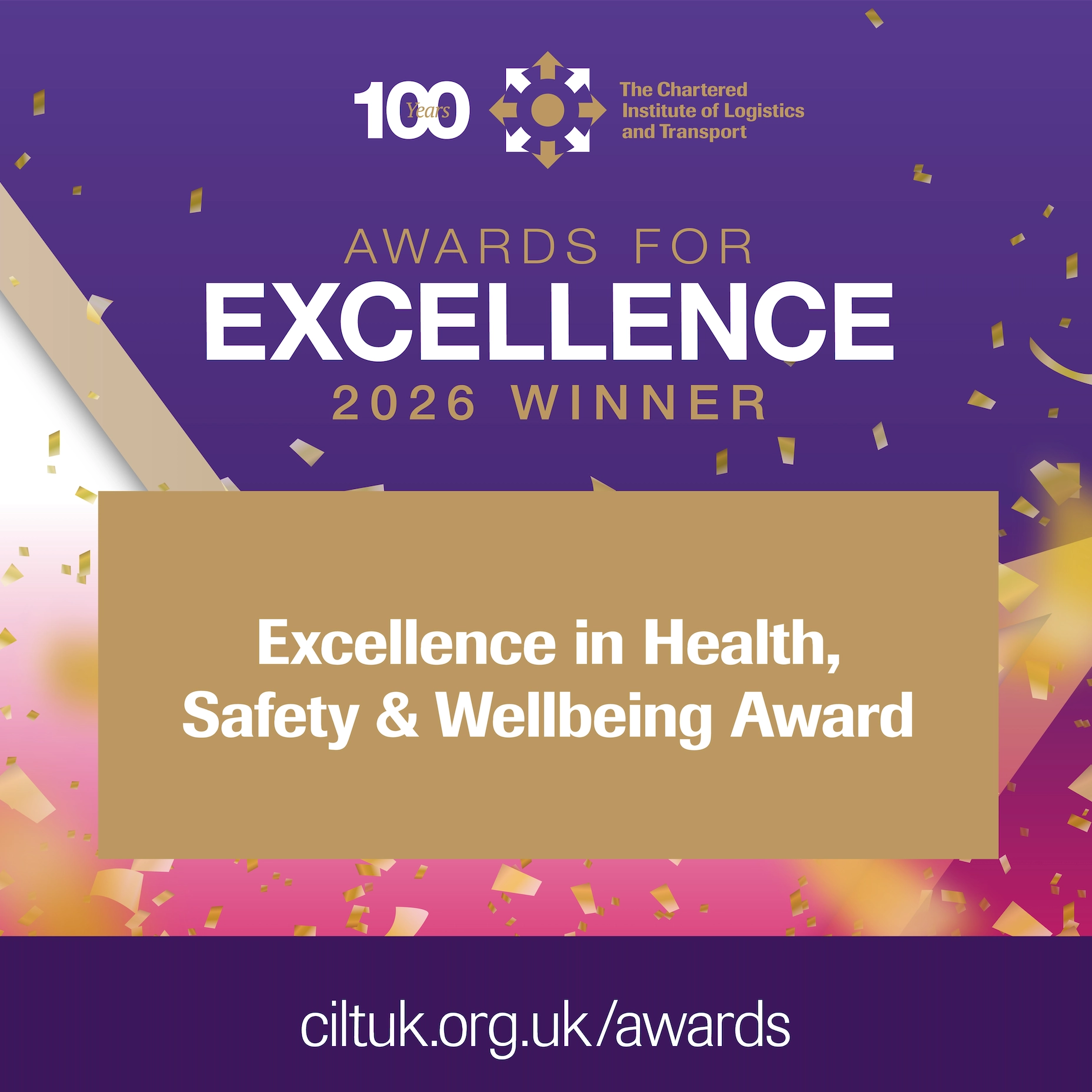
CILT Awards for Excellence
2026 Winner Excellence in Health, Safety & Wellbeing Award
Professional recognition associated with the development journey, presented using the supplied CILT award wording.
Professional recognition is distinct from methodological validation. This award reference does not mean that CILT has formally validated or endorsed the WSRI methodology.
09 / Stakeholder engagement
Help shape the way we manage driver wellbeing
The next stage is intended to bring together people with different experience and expertise to scrutinise, challenge, develop and ultimately test WSRI.
Expressions of interest are welcome from road transport operators, Transport Managers, professional drivers, academics and researchers, driver-health and wellbeing specialists, professional bodies, industry organisations, and regulatory or enforcement stakeholders.
No organisation is identified here as a confirmed partner. The invitation is to contribute to future development and scrutiny.
The intention is to develop a real-world pilot with relevant stakeholders and volunteer road transport operators. The proposed approach would:
Present the current methodology for stakeholder scrutiny and challenge.
Work with participating operators and stakeholders to make the framework practical and proportionate.
Apply the developing audit methodology and gather organisational, workforce and operational evidence.
Examine whether it produces meaningful workforce sustainability risk signals.
Explore whether those signals help operators identify and understand factors affecting driver wellbeing and human capacity.
Refine the methodology using evidence and stakeholder feedback.
Seek independent evaluation of the methodology and findings.
This is a proposed next stage. The page does not claim that a pilot is formally approved, funded or already underway.
11 / Long-term ambition
Could workforce sustainability become a recognised part of operator risk management?
Subject to successful piloting, independent evaluation and further research, the longer-term ambition is to investigate whether Workforce Sustainability Risk could become a recognised component of operator risk management and potentially complement existing Roadworthiness and Traffic risk approaches.
Roadworthiness
An existing operator risk approach.
Traffic / compliance
An existing operator risk approach.
Workforce sustainability
A research proposition for future investigation.
This may include investigating its potential relationship with OCRS. Workforce Sustainability Risk is not currently an OCRS dimension. No regulatory adoption, approval or support from DVSA, DfT, Traffic Commissioners or government is claimed.
12 / About the originator
Wayne Reidie MBA FCILT
Originator and Lead Developer of WSRI Director, Customer 1st (UK) Ltd
Wayne brings experience of professional driving, Transport Management, transport operations, business ownership, workforce and labour provision, training, consultancy and research.
WSRI has developed from direct exposure to the operational realities of road transport. Its positioning is practitioner-led research, open to independent challenge and collaborative development, with clear provenance of the original concept and methodology.
13 / Read the research
WSRI V.3
Workforce Sustainability Risk Index A Practical Guide for Transport Operators
Current research manuscript · Wayne Reidie MBA FCILT · 338-page supplied PDF
The current research document is provided for review of the developing methodology. Read it alongside the developmental status and limitations set out on this page.
The WSRI book is available for £149: choose digital access or a hard copy with UK postage included. Online payment is coming soon. Digital reading is restricted to authorised readers. Selected audit examples and prototype screenshots are shown above. The full audit template and supplied executive summary remain private source material.
14 / Get involved
Interested in contributing to the development or pilot of WSRI?
Contact Wayne to express interest in stakeholder scrutiny, academic challenge, operator participation or future pilot development.
An expression of interest does not establish a partnership or commit an organisation to participation.
Research status. WSRI is a developing research methodology. It is not currently a regulatory standard or component of OCRS. Any future regulatory application would be subject to research, independent evaluation and consideration by the appropriate bodies.
WSRI has not been presented here as government approved, CILT endorsed, academically validated or approved by DVSA, DfT, Traffic Commissioners or any other stakeholder. No guaranteed effects on safety, health, absence, productivity or compliance are claimed.